Golf on the Costa del Sol | Courses, Costs and Booking Guide
Golf on the Costa del Sol
The Costa del Sol is frequently called the Costa del Golf, a title earned by the highest concentration of golf courses in continental Europe. More than 70 courses line this 160-kilometre stretch of coastline. Development began in earnest during the 1960s, heavily influenced by the arrival of course architect Robert Trent Jones Sr, who designed several of the most prominent layouts in the region. The primary appeal for international golfers is the climate: even in January, daytime temperatures regularly reach 18°C, and the region averages 320 days of sunshine per year.
The geography dictates the style of play. Many courses are carved into the foothills of the Sierra Blanca and Sierra de Mijas mountains, resulting in significant elevation changes, sloping fairways, and the near-universal requirement for a buggy. Bermuda grass covers most fairways: it goes dormant and turns brown in winter, while greens are typically Agrostis for a fast, consistent putting surface year-round.
Green fees vary considerably by club prestige and season. During peak periods (March to May, September to November), expect to pay €70 to €150 for a standard 18-hole round at a well-maintained resort course. The most exclusive championship venues charge upwards of €400.
Peak season is March to May and September to November. Fees drop outside it, and every band here is taken from the course details further down this page.
| Where | Courses | What you are in for | Green fee |
|---|---|---|---|
| Mijas and Fuengirola | Mijas Golf: Los Lagos and Los Olivos | Los Lagos is wide with seven water hazards, Los Olivos is tighter and lined with olives | €70 to €150 peak |
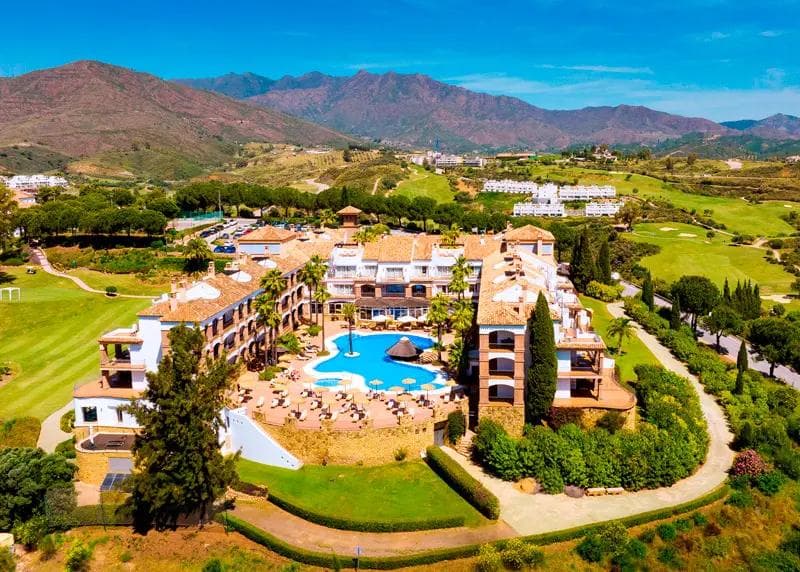
| Mijas | La Cala Resort: America, Asia, Europa | Largest complex in Spain and genuinely hilly. The buggy is not optional here | €70 to €150 peak |
| Marbella, Golf Valley | Aloha, Los Naranjos | Established parkland in the valley behind Puerto Banús | €70 to €150 peak |
| Casares | Finca Cortesin | Hosted the 2023 Solheim Cup. Scale and conditioning are the draw | Around €300 |
| Sotogrande | Real Club Valderrama, La Reserva | Valderrama hosted the 1997 Ryder Cup. The top of the game in Spain | €400 and up |
| Estepona to Sotogrande | Estepona Golf | The value end of the coast without a drop in condition | Below the resort band |
Mijas and Fuengirola
The area surrounding Mijas and Fuengirola acts as the practical heart of the golf industry on the coast. It is accessible from Málaga airport, offers a range of price points, and contains some of the most frequented resort complexes in Spain.
Mijas Golf is the most prominent facility here, featuring two distinct 18-hole courses: Los Lagos and Los Olivos. Los Lagos was recently renovated and features seven large water hazards. The fairways are wide and the greens are expansive, making it a fair test for mid-handicap golfers. Los Olivos is tighter, lined with olive trees that penalise errant tee shots and require technical accuracy over raw distance.
Nearby, La Cala Resort is the largest golf complex in Spain, running three full 18-hole courses: America, Asia, and Europa. These courses are notoriously hilly. Playing without a buggy is physically exhausting and often prohibited to maintain pace of play. The Asia course is the shortest but most difficult, with narrow fairways and small elevated greens. America offers wider views and more room off the tee. Green fees at La Cala typically range from €65 to €95, often including a shared buggy.
Further down towards the coast, Santana Golf is built on the site of a former avocado plantation. Unlike its mountain neighbours, the terrain here is relatively flat, making it one of the few courses on the coast that is comfortable to walk. The layout is technical but fair, with each hole separated by rows of fruit trees. It is a popular choice for local golf societies, and booking at least two weeks in advance is essential for morning tee times.
The Marbella Golf Valley
Located just inland from Puerto Banús, the Nueva Andalucía area is known as the Golf Valley. This small geographical radius contains several of the most famous clubs in Spain. Real Club de Golf Las Brisas is the centrepiece, an exclusive club that has hosted the World Cup of Golf and the Spanish Open. It is a design by Robert Trent Jones Sr featuring numerous bunkers and water hazards that demand strategic placement rather than power.
Aloha Golf Club and Los Naranjos Golf Club complete the primary trio in the valley. Los Naranjos is particularly popular with Scandinavian golfers and features two distinct nines. The front nine is undulating with narrow fairways; the back nine flattens out but is guarded by mature orange trees. Green fees in the Golf Valley typically start at €120 and reach €180 during peak weeks.
While many of these clubs are private, they open daily time slots for visitors. They enforce strict handicap limits: men require a certified handicap of 28 or lower, women 36 or lower. You must present your physical or digital handicap certificate at the pro shop before paying your green fee.
Sotogrande
At the western edge of the Costa del Sol, near the Gibraltar border, lies Sotogrande. This is the location of the highest echelon of golf in Spain. Real Club Valderrama hosted the 1997 Ryder Cup and is consistently ranked as the best course in continental Europe. Playing Valderrama costs upwards of €450. The course is maintained to a standard rarely seen outside major tournament venues, but it is also among the most difficult. Cork trees line every fairway with low overhanging branches that punish a slightly offline drive.
Directly adjacent sits the Real Club de Golf Sotogrande, the first course Robert Trent Jones Sr designed in Europe. It is a long, demanding track characterised by large, fast greens and strategically placed bunkers. Feeling more open than Valderrama, the coastal winds that blow through the palm trees provide a constant challenge to club selection.
A newer addition to this cluster is La Reserva Club. Opened in 2003, it sits on a large hillside with very long holes and significant water features. The clubhouse is one of the most luxurious on the coast, reflected in the €200-plus green fee. These Sotogrande courses are less crowded than those around Mijas or Marbella: the high entry price and distance from Málaga airport filter the visitor numbers naturally.
Western Costa del Sol
For golfers seeking more affordable options without sacrificing quality, the stretch between Estepona and Sotogrande offers strong value. Estepona Golf is a well-regarded local course with a more relaxed atmosphere than the prestigious Marbella clubs. The layout is challenging, particularly the par-three 14th which requires a shot over a deep ravine, but green fees drop as low as €50 in low season.
Valle Romano Golf and Resort sits just west of Estepona town. It is a modern, championship-length course that has hosted several professional tournaments. The facility includes a large clubhouse, excellent practice facilities, and a grass driving range. It is frequently bundled into "play and stay" packages with local hotels, making it a cost-effective base for a week's golf holiday.
Finca Cortesin, located in Casares, represents the modern peak of the western coast. It hosted the 2023 Solheim Cup and is famous for its scale and conditioning. Green fees are around €300, but the experience includes a personal greeting, a GPS-equipped buggy, and complimentary practice balls. The course stretches nearly 7,000 metres from the back tees and features more than 100 bunkers.
Where to Stay
On-Course Rules and Etiquette
The golf industry on the Costa del Sol runs to a professional standard, but operates under strict rules that visitors must follow. The dress code is consistent across all clubs: collared polo shirts, tailored trousers or shorts, and golf shoes with soft spikes. Denim, tracksuits, and football shirts are prohibited. Most clubs will ask you to purchase appropriate clothing from the pro shop if you arrive incorrectly dressed.
Tee times are usually spaced eight to ten minutes apart. Slow play is a persistent issue due to the difficulty of the terrain. If your group falls behind the club's allowed time (typically four hours and thirty minutes for a four-ball), a course marshal will ask you to skip to the next hole. Most courses operate a Ready Golf policy: if you are ready before the player whose honour it is, you play first.
Equipment and Getting There
Flying into Málaga with clubs has a cost. Ryanair and EasyJet charge €40 to €60 per flight to transport a golf bag, with the risk of damage or loss during handling. A popular alternative is club hire from a service at the airport itself, such as Clubs to Hire. You can rent a current set of TaylorMade or Callaway clubs for around €60 per week, collecting and dropping off at the arrivals terminal.
Transporting a group of golfers requires planning. A standard hatchback will not fit four adults and four golf bags. Most visitors hire a large people-carrier or use a golf transfer company. These provide door-to-door service from your hotel to the course in a minibus with space for bags, which is particularly useful if the group plans to use the 19th hole. A transfer from Marbella to a course in Mijas costs around €80 for a group of eight.
If you drive, the AP-7 toll road is the most reliable route to the major golf zones. Exits are marked with blue signs featuring a golf ball icon. Avoid the coastal N-340 during peak morning hours. Most clubs cancel your slot without a refund if you arrive more than 15 minutes late.
Booking Tips
For spring or autumn trips, book tee times three to six months in advance. Using a local golf agency often costs less than booking directly with the clubs. These agencies buy blocks of tee times at wholesale prices and pass the savings on, and they can arrange circuit packages allowing five different courses over a week at a discounted rate. It is worth comparing prices online too, where you can book Costa del Sol golf tee times before you fly and lock in the courses you most want to play.
Low season months (July, August, January, February) offer the lowest prices. In summer, many courses offer early-bird specials where you tee off at 7:30am and finish before the midday heat becomes uncomfortable. In winter, rain can trigger "Path Only" rules for buggies, which slows play considerably. Most clubs issue a rain voucher if the course becomes unplayable, but cash refunds for weather are rare.